

Perkins Pointers from Rock Valley, Iowa, 1899
The Hackett, Cable, and Lincoln families' business in print

I ran across a very interesting newspaper tidbit when I recognized several names.
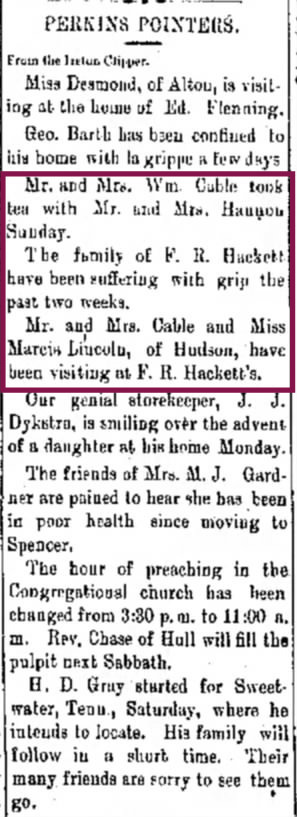
I found this clipping because of a search I was doing to try to get more information on a grandson of Marcia (Lincoln) Cable - specifically Harry Cable, son of Jonathan William Cable and Mary Blundell.
To discern exactly who is who in this, I have to back up a bit and keep in mind the date.
F.R. Hackett of Iowa is Frederick Ralph Hackett, my maternal grandmother’s maternal grandfather (he was husband of Emily Esther Lincoln). They had a 10-year-old, 8-year-old, 6-year-old, and a toddler at the time of the article. And apparently they had all been ill (“the grip”).
Mr. and Mrs. Wm Cable could be Jonathan and Mary. Jonathan William went by “Will” and they lived in Iowa - unlike the other Cables, who remained in South Dakota. Also, other Perkins Pointers from the same paper in the year prior, and then Scott Mills Briefs (Statesman Journal, Salem, Oregon) in 1919 line up mentions of this couple with where their family lived.
Who Miss Marcia Lincoln refers to was not immediately clear. However, after looking at every known Marcia in my tree, I found that Sanford Elisha Lincoln had a daughter named Marcia who would have been 18 or 19 at the time of the article, and she was Emily Esther’s cousin. On the 1900 census she lived in Sioux Falls, South Dakota, which is a common enough secondary locale for the cousins who lived in Hudson. Marcia’s mother, Sanford’s first wife, had died in 1885 and her father remarried in Arkansas in 1890, where he started a new family. So she had probably been living in Hudson with cousins. Three years later she would marry John Newell in Missouri.
It’s interesting to run across these types of news briefs. I’d like to say that I can’t imagine such wide circulation of one’s insignificant comings and goings, but I couldn’t say that with a straight face as I get notifications from social media. It does make family history research a little more real - giving a small glimpse into the lives of people I feel connected to but will never meet. So as odd as such reporting seems, I’m grateful for it.